
ORGANIZATIONAL IMPLEMENTATION
Strengthening Veteran Support Within Your Organization
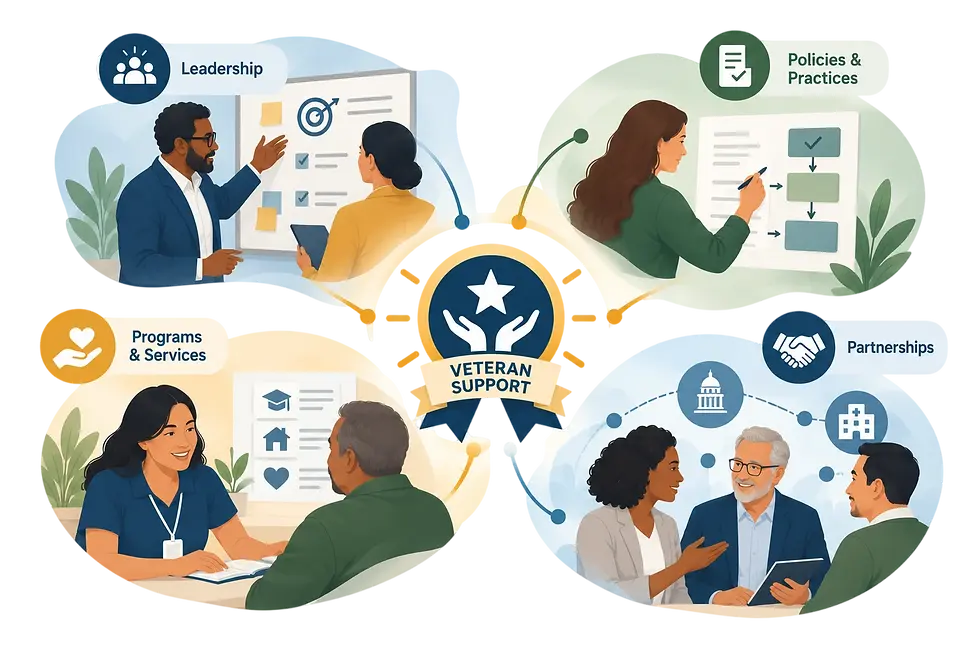
Organizations influence Veteran well-being through more than the services they provide. Their leadership, policies, everyday practices, and partnerships shape how Veterans are welcomed, supported, and connected to opportunities.
Whether supporting Veterans is central to your mission or one part of your broader work, your organization can examine its current practices, explore approaches that fit its role, and identify meaningful actions to strengthen Veteran support.

Organizational Leaders & Decision-Makers
Set priorities, shape policies, allocate resources, and influence the organizational culture and systems that support Veterans.
WHO INFLUENCES THIS WORK
The Roles That Shape Veteran Support
Strengthening Veteran support involves people across an organization and its partnerships. Different roles influence the decisions, experiences, and connections that shape how support is provided.

Program & Service Teams
Shape Veterans' everyday experiences through program design, service delivery, accessibility, responsiveness, and connections to support.

Coalition & Network Leaders
Help participating organizations coordinate efforts, strengthen partnerships, share knowledge, and improve connections between services and systems.
FIND YOUR STARTING POINT
What Are You Hoping to Achieve?
Strengthening Veteran support can begin with different questions. Choose the starting point that best reflects your organization's current focus. Each resource offers a different perspective, and insights from one can inform how you use another. Start wherever it makes sense, and revisit or combine resources as your priorities evolve.

Understand Your Organization's Current Practices
How do our practices, systems, and decisions shape Veteran support?
Baldrige-Informed Self-Assessment

Explore Approaches
To Better Support Veterans
What forms of Veteran support align with our mission and role?
Recognition Designation Framework

Plan Your Organization's
Next Steps
How can we put our ideas for stronger Veteran support into action?
Implementation Workbook
How Can These Resources Support Your Work?
Through interviews with subject matter experts and organizations across North Carolina, we've gathered insights into organizational practices, challenges, and opportunities for strengthening Veteran support.
These insights informed three complementary resources focused on organizational self-assessment, approaches to Veteran support, and implementation planning. Each resource offers a different perspective to help organizations recognize existing strengths, consider opportunities for improvement, and identify priorities that align with their mission and capacity.

PLAN your approach and next steps
Implementation Workbook
This implementation workbook offers practical resource to help organizations move from reflection and exploration toward meaningful action.
It may help teams organize what they've learned, identify priorities that fit their mission and capacity, and consider next steps for strengthening Veteran support.
this resource explores
recommended next steps
After exploring this resource, consider how the other tools might help you build on what you've learned or take your work further.
You're developing an action plan, but what organizational strengths or challenges could affect its success?
The Baldrige-Informed Self-Assessment can help you examine organizational capacity, leadership support, staff practices, and existing systems that may influence implementation.

You're planning ways to strengthen Veteran support. Could other approaches help you expand or refine your ideas?
The Recognition & Designation Framework can help you consider additional Veteran-Friendly, Veteran-Supportive, and Veteran-Ready approaches that may inform your priorities.

Priorities and Opportunities
Identifying areas of focus that align with organizational goals and Veteran needs.
Actions and Next Steps
Considering practical ways to strengthen existing efforts or explore new approaches.
Resources and Partnerships
Reflecting on the people, capacity, relationships, and support that may be available or needed.
Progress and Adaptation
Considering how organizations might recognize progress, learn from experience, and adjust their approach over time.
EXPLORing THE TOOLS
understand your organization's current practices
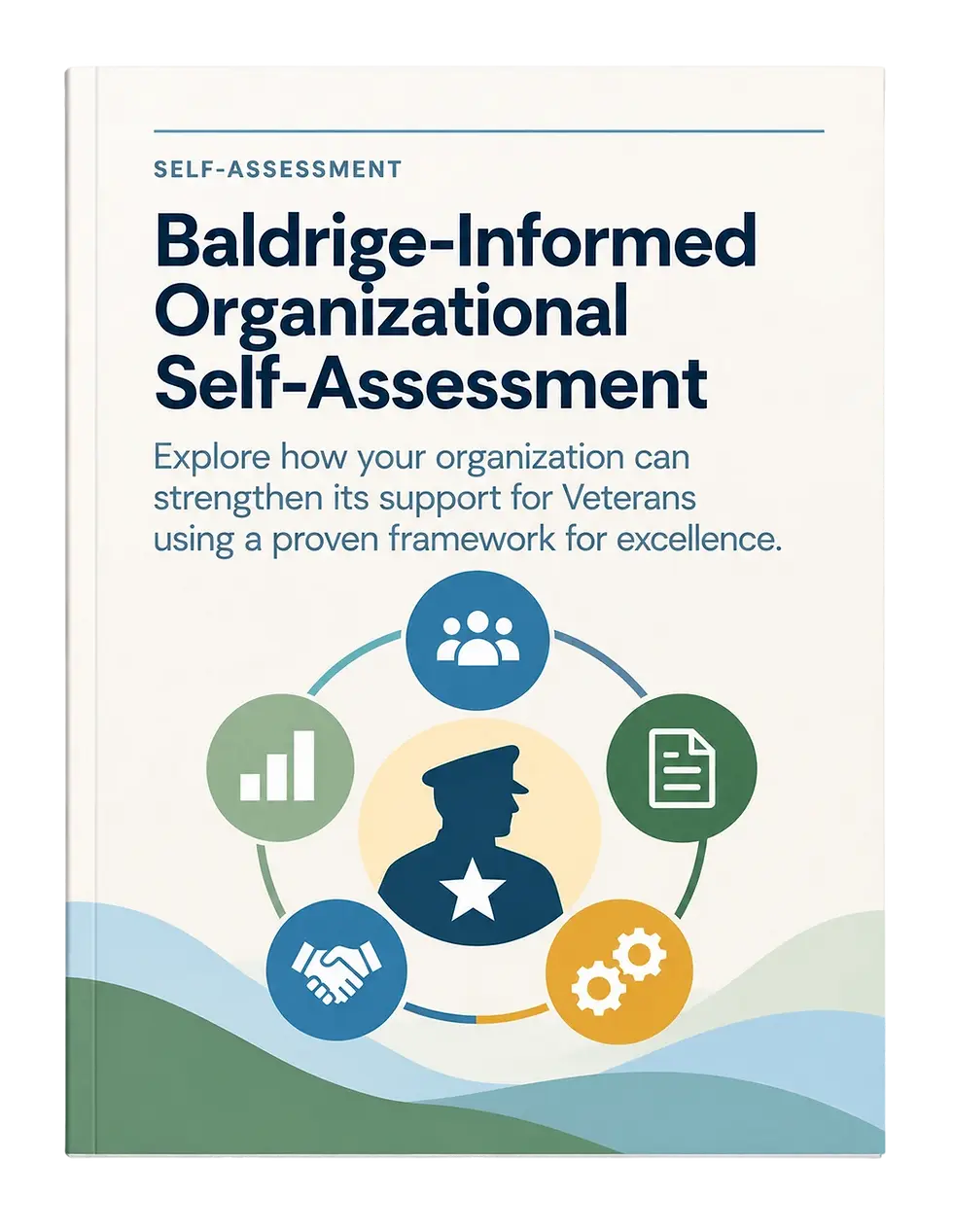
Baldrige-Informed Organizational Self-Assessment
Take a closer look at your organization's leadership decisions, everyday practices, staff experiences, and partnerships that shape Veteran support.
Informed by the Baldrige framework for organizational excellence, it offers a broader perspective for recognizing what's working, uncovering potential gaps, and identifying opportunities for meaningful improvement.
THIS assessment exploreS
Leadership and strategic direction
Partnerships and coordination
Staff readiness and organizational capacity
Understanding of Veteran needs
Operations and service practices
Measurement and continuous improvement
recommended next steps
After exploring this resource, consider how the other tools might help you build on what you've learned or take your work further.

You've recognized practices that already support Veterans. How could you build on those strengths?
The Recognition & Designation Framework can help you explore how those strengths relate to different approaches to Veteran support and consider opportunities to expand your efforts.

You've identified gaps or opportunites in your organization's practices. How could you begin addressing them?
The Implementation Workbook can help you identify actions, clarify responsibilities, and organize a practical plan for strengthening Veteran support.

explore VETERAN-supportive APPROACHES
Recognition and Designation Framework
A developing framework to help organizations explore different ways their practices, services, and systems can contribute to Veteran well-being. It introduces three distinct approaches to support, recognizing that organizations contribute in different ways depending on their missions, roles, and capacities.
veteran -friendly
Creating environments where Veterans feel welcome, recognized, and respected.
See the Registry Recommendations Guide page 27
Veteran-Friendly organizations demonstrate an awareness of Veterans and their families and take intentional steps to create a sense of welcome and belonging.
This may be reflected in everyday interactions, organizational culture, communication, and efforts to recognize and appreciate military-connected individuals.
Focus Area or Criteria 1
See the Registry Recommendations Guide
Use relevant keywords to improve online search visibility
Create simple flyers with a QR code linking to the registry
Add the registry link to staff email signatures
Promote the registry on social media
Distribute printed materials at clinics, events, and community spaces
Focus Area or Criteria 2
See the Registry Recommendations Guide pages 4, 5, 9, 25 - 28
Ensure the guide is printable and easy to view on screen
Use a mobile-friendly layout compatible with phones and tablets
Select clear, readable fonts and font sizes
Provide concise descriptions for each resource
Avoid distracting visual elements
Include a verification badge (e.g., "Verified: Month & Year")
VETERAN-SUPPORTIVE
Providing practical services and support that respond to Veterans' needs.
See the Registry Recommendations Guide page 12
Veteran-Supportive organizations go beyond creating a welcoming environment by incorporating meaningful support into their programs, services, and everyday operations.
Their efforts may include dedicated resources, tailored services, knowledgeable staff, or relationships that help Veterans and their families access assistance relevant to their circumstances.
Focus Area or Criteria 1
See the Registry Recommendations Guide pages 13, 20 - 22
Use multiple verification channels that align with how your registry collects information
Include direct contact verification (phone, email, or in-person confirmation)
Use self-attestation forms for organizations to confirm service details
Consider automated feeds from trusted systems (e.g., VA directories, licensing boards)
Conduct periodic staff reviews by trained verification specialists
Focus Area or Criteria 2
See the Registry Recommendations Guide pages 13, 18
Prioritize updates for critical or high-demand resources
Use automation tools as a preliminary step for validating registry entries
Create a manageable update schedule that registry staff can sustain
Delegate updating tasks to trusted volunteers or interns by service type or geography
Maintain a simple update log to track when and what was updated
Focus Area or Criteria 3
See the Registry Recommendations Guide pages 20 - 22
Add a Report an Issue button for each resource entry
Invite organizations and partners to review their listings via automated emails or update portals
Flag outdated entries that have not been updated within the past year
Display resource metadata such as last updated date and expected update frequency
Prioritize verified entries in search results or categories
veteran-ready
Strengthening systems and partnerships so Veterans can navigate support more easily.
See the Registry Recommendations Guide pages 25 - 26
Veteran-Ready organizations focus on how different parts of a support system work together.
Drawing on experience, coordination, and collaboration, they help create clearer pathways between services and reduce the likelihood that Veterans encounter unnecessary barriers or become disconnected while seeking assistance.
Focus Area or Criteria 1
See the Registry Recommendations Guide pages 23 - 24
Synch or import updates from registry partners that maintain parallel or overlapping directories
Coordinate distribution efforts with other local or state-level registries
Share and request feedback from established or well-utilized registries
recommended next steps
After exploring this resource, consider how the other tools might help you build on what you've learned or take your work further.
You've found an approach that fits your mission. How well do your organization's current practices support it?
The Baldrige-Informed Self-Assessment can help you examine the leadership, policies, workforce, and organizational systems that may influence your ability to support that approach.

You've identified an approach to Veteran support that feels right for your organization. How could you put it into practice?
The Implementation Workbook can help you translate that direction into concrete actions, responsibilities, and resource considerations.

Build on What You've Discovered
CONTINUE LEARNING & EXPLORING
Strengthening Veteran support involves many areas of learning and action. Explore related pathways to deepen your understanding, discover practical resources, and consider additional opportunities that may complement your organization's work.
Strengthening Resource Coordination & Navigation
Guidance and technology to help organizations strengthen resource information, improve referral systems, and connect Veterans and communities with the services they need.
Maps & Data Insights
Explore county-level maps and data that highlight community conditions, service availability, and patterns in access to help inform local decisions.
How Systems Work
Plain-language explanations and visual models that show how services, access, and outcomes are connected, helping communities identify gaps and opportunities for improvement.
Start Your Learning Journey
Find learning resources, practical tools, and examples that support awareness, partnerships, understanding community conditions, and local action.